A pessary is a silicone support device worn inside the vagina to manage symptoms of pelvic organ prolapse or stress urinary incontinence. It holds prolapsed pelvic organs in place and offers a minimally invasive, conservative treatment option.
Because a pessary supports the bladder, uterus, and rectum, it can change how bowel movements feel. Depending on the type of prolapse and how the pelvic floor muscles respond, passing stool may become easier, harder, or stay about the same.
Pelvic floor physical therapy helps patients coordinate and relax these muscles so bowel movements become more comfortable. Working with a pelvic floor PT also helps determine whether a pessary is the right fit for your symptoms and, if that’s the case, a pelvic floor PT can fit you for a pessary in the office.

If you're reading this post, you've likely heard of a pessary and what it is used for. At this point, you're just doing research to see what the effects are once you have one.
You may wonder if pessaries affect bowel movements. They may make them harder, easier, or somewhere in between.
This blog post explains what a pessary is and where it sits in the body. It also covers bowel movement details. You will also learn where to find pessary fittings in Doylestown and Newtown, Pennsylvania.
What a Pessary Is and How It Works
A pessary is a silicone support structure that sits in the vagina and helps to support the pelvic organs. Someone would wear a pessary in order to manage symptoms of pelvic organ prolapse or stress urinary incontinence.
Pelvic organ prolapse is a condition in which one (or more) of the pelvic organs sits lower in the pelvis and, as a result, can cause heaviness, pelvic pressure, and bowel and bladder changes like difficulty passing urine or stool or, as mentioned above, leaking.
Pelvic organ prolapse occurs due to a loss of pelvic muscle and ligament support.
Since prolapse can affect the bladder, urethra, uterus, and rectum, a pessary can be used to support these organs to help manage symptoms and for minimally invasive, conservative treatment of pelvic symptoms and diagnoses.
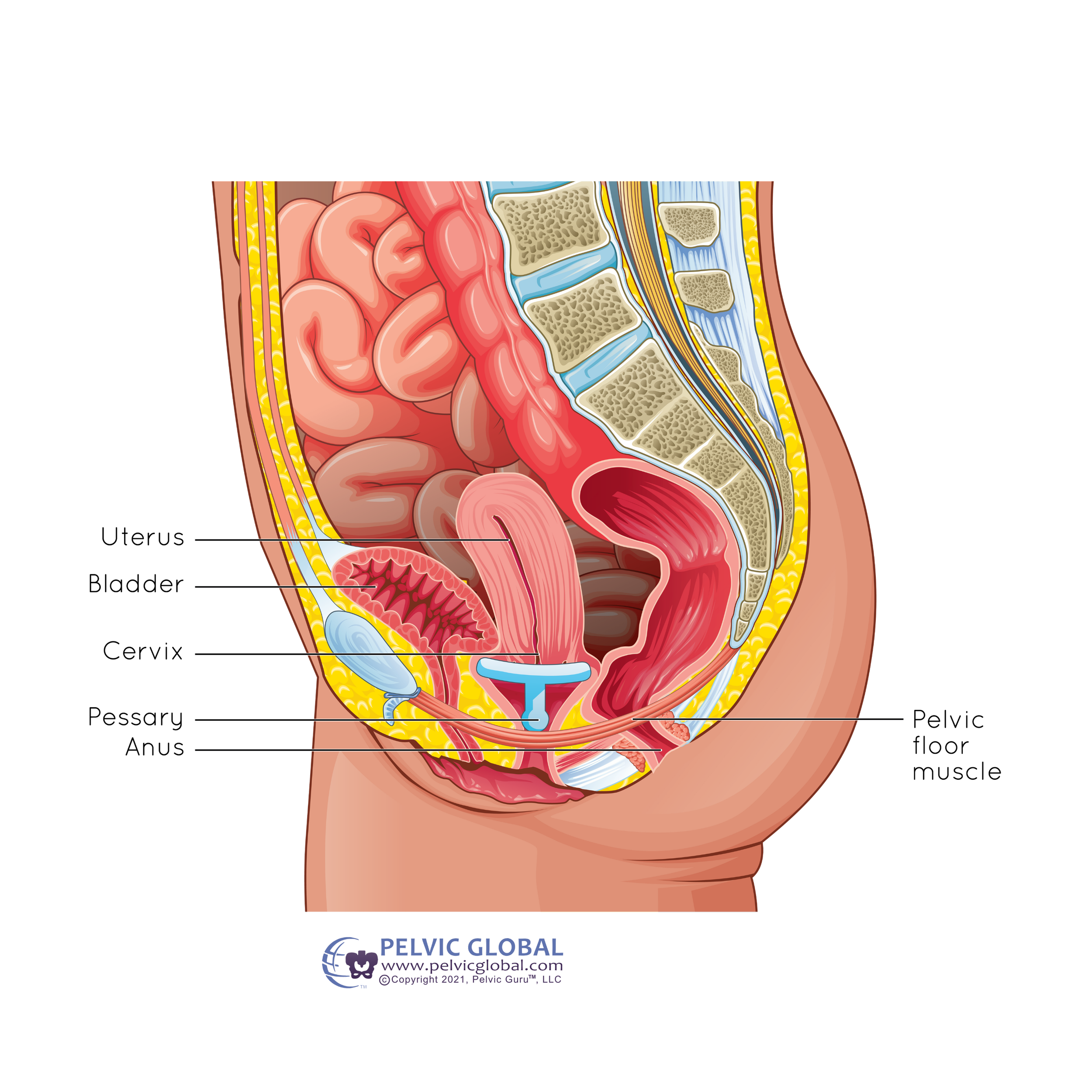
This is an example of how a Pessary sits in the body.
Image used with permission from Pelvic Guru®, LLC as a Pelvic Global Member
How a Pessary Sits in the Body
A pessary sits within the vaginal canal, at the top part of the vagina near the cervix. The type of pessary will dictate exactly how it sits in the vagina.
A pessary holds the pelvic organ that is prolapsed in place. This allows the pelvic ligaments that are damaged to shorten and stiffen. Pessaries prevent the prolapsed pelvic organ from collapsing into the vaginal opening.
Why Bowel Movements Can Feel Different With a Pessary
We first have to define if you have a rectocele, which is a prolapse that is affecting where the end of your large intestine (your rectum) sits.
If you have a rectocele, we next have to figure out which ligaments are impacted.
You can have a rectocele that is the result of ligament laxity in the upper part or the lower part.
Low lying rectocele’s occur when the ligaments lower down in the rectum are affected.
The ability to use a pessary treatment when someone has a low lying rectocele is limited. This is because the pessary sits much higher in the pelvis than where the support it needed.
As a result, passing bowel movements can become more affected and harder to pass. This would be a side effect of pessary treatment, which means it may not be utilized at all.
Alternatively, some people need training on how to relax their pelvic floor.
Patients with prolapse tend to grip their pelvic floor muscles, especially those who have had prolapse for a number of years.
The pelvic floor muscles work so hard to support the organs that when we put in a pessary/support device, the muscles are unsure of how to let go.
In this situation, patients need to attend pelvic floor physical therapy in order to learn how to coordinate and relax their pelvic floor, in order to make bowel movements easier.
Lastly, sometimes the pessary can fall out when a patient is having a bowel movement.
This occurs because patients generate excessive force and bear down too much, which causes the pessary to fall out. Learning how to push without generating too much force is an important thing to learn in pelvic floor PT.
Sometimes, as a short-term solution, we have to instruct patients to remove the pessary while having a bowel movement and reinsert it once they are finished with toileting.
But if the pessary is falling out during bowel movements, you might also need another type of pessary.
Types of Pessaries and Their Fit Differences
There are two main types of vaginal pessaries: support and space-occupying.
Both types of pessaries sit in the vagina and are used to push out into the organs and prevent the organs from pushing down into the vagina.
Support type pessaries are the most commonly fitted pessary, but they aren’t always the best option for patients, especially those who have pelvic floor muscle weakness or damage.
Support pessaries require support from the pelvic floor muscles in order to be held in place. The pessary sits in the vagina and rests right on top of the pelvic floor muscles. Examples of support pessaries are rings and dishes.
Support type pessaries can stay in for about 3 months and don’t need to be removed daily. We do have some patients who remove them for penetrative intercourse, while others don’t need to.
Space-occupying pessaries push out into the walls of the vagina to prevent anything from pushing into them. They sit in the vagina like a tampon and suction to the vaginal walls and the bottom of the cervix. Examples of space-occupying pessaries are cubes and gelhorns
Space-occupying pessaries don’t allow much drainage of vaginal discharge, they must be removed every day. We tell patients that you must clean your pessary and there should never be a foul smell associated with the pessary. You also must remove a space occupying pessary in order to have penetrative intercourse.
When to Talk to Your Provider About Symptoms
If you are experiencing difficulty with bowel movements, constipation, or even feeling a lot of pelvic pressure and heaviness, you should chat with your provider.
A pessary might be a great way to manage symptoms, depending on the type of prolapse you have.
In addition, if the heaviness in your vagina is worse after activity, and as the day progresses, you should be assessed by a pelvic floor PT because you may also be a great candidate for a pessary.
Where to Find Pessary Fitting in Bucks County
Vivid Women’s Health is a women’s health physical therapy practice with two locations. We have one in Newtown, PA and one in Doylestown, PA. We provide unmatched pelvic floor physical therapy to help women resolve pelvic floor symptoms.
If you are local to the Newtown, PA or Doylestown, PA, Bucks County area, please click here to find out more about our in person services. If you are visiting our site from afar, we offer virtual services to help you overcome your pelvic health concerns. For virtual pelvic floor care, please click here.
We proudly put our patients first by offering one-on-one appointments for a full hour. You will have time to be heard and we will take time to listen to your whole story.
You won’t be passed between different professionals and we will work to get you a holistic solution to your pelvic health concerns.
We choose to participate in a private pay model so that we can focus on putting patients first.
We'd love to help you with pessary support. Feel free to contact us or book online today.